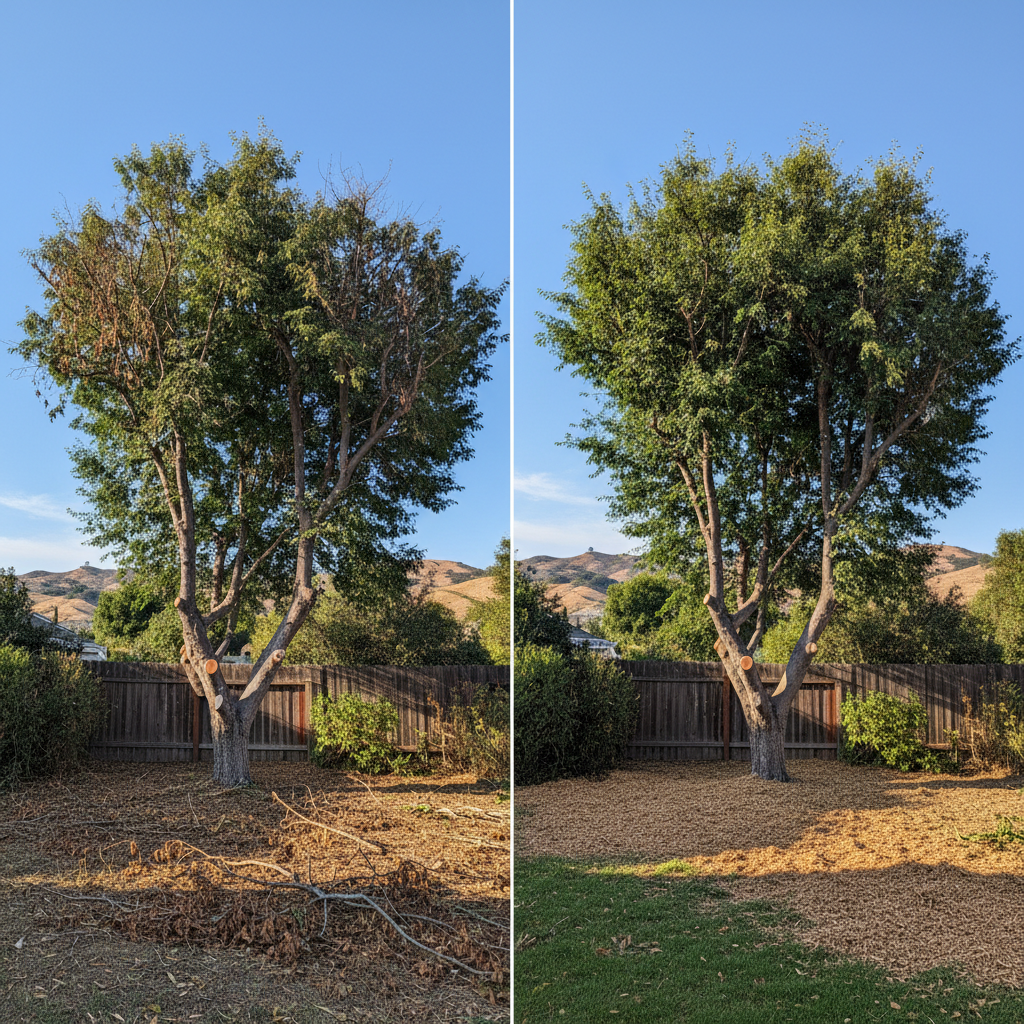
You've got a tree that's gotten a bit too big for its britches, right? Maybe it's brushing against the house, or blocking too much sun, or just looks unruly. So, you start thinking about getting it trimmed. That's a smart move for tree health and safety. But here's where you hit a fork in the road, and choosing the right path makes all the difference for your tree's future, and your wallet.
What's the Deal with Tree Topping?
Let's talk about 'topping' first, because it's something I see all too often, especially in older neighborhoods with mature trees like those big sycamores or oaks common around the Friendly Hills area. Topping is basically cutting off the entire top of a tree, or large sections of its main branches, without any regard for where the cuts are made. Think of it like giving a tree a really bad, blunt buzz cut. People usually do it because they want to drastically reduce the tree's size quickly, or they think it'll make the tree safer.
Sounds simple, right? Just chop the top off. But here's the kicker: it's almost always a terrible idea. When you top a tree, you remove a huge amount of its leaf-bearing crown. Leaves are how a tree makes its food. Taking too many away at once sends the tree into shock. It'll try to recover by sending out a bunch of weak, fast-growing shoots called 'water sprouts' or 'epicormic growth' right below those big, ugly cuts. These sprouts are poorly attached and grow incredibly fast, often making the tree look even worse and become more dangerous in the long run.
The True Cost of Topping
You might think topping is cheaper upfront because it's a quick, brutal job. And sometimes, it is. But let's look at the real costs:
- Durability & Health: Topped trees are stressed trees. They're more susceptible to disease, insect infestations, and sun scald because their protective canopy is gone. Those water sprouts? They're weak. They're prone to breaking off in strong winds, which we certainly get here in Southern California, especially during Santa Ana conditions. This means a topped tree is actually less durable and more likely to suffer structural failure down the line.
- Appearance: Honestly, topped trees look awful. They lose their natural shape and often end up looking like a hat rack or a mutilated stump with a bunch of skinny twigs sticking out. It's not just an aesthetic thing; it's a sign of a severely damaged tree.
- Maintenance: Because those water sprouts grow so fast, a topped tree will need trimming again much sooner than a properly pruned one. You're basically signing up for more frequent, and often more expensive, maintenance cycles to deal with the mess topping creates.
- Long-term Value: A healthy, well-maintained tree adds value to your property. A topped, struggling tree can actually detract from it.
Enter Proper Pruning: The Smart Choice
Now, let's talk about proper pruning. This is the professional, arboriculture-approved way to trim a tree. It's about making strategic, thoughtful cuts to improve the tree's health, structure, and appearance. When I talk about proper pruning at Oasis Tree, I'm talking about techniques like:
- Crown Thinning: Removing select branches to improve air circulation and light penetration within the canopy. This helps reduce disease risk and allows light to reach your yard.
- Crown Raising: Removing lower branches to provide clearance for pedestrians, vehicles, or structures.
- Crown Reduction: Carefully reducing the height or spread of a tree by cutting branches back to a lateral branch that's large enough to sustain the remaining limb. This is NOT topping; it respects the tree's natural form and growth patterns.
- Deadwood Removal: Taking out dead, dying, or diseased branches, which is crucial for safety and tree health.
These methods are based on how a tree naturally grows and heals. Cuts are made at specific points, usually just outside the branch collar, which allows the tree to compartmentalize the wound and heal effectively.
Why Proper Pruning Wins Every Time in Whittier
For homeowners here in Whittier, proper pruning is hands down the better investment:
- Durability & Health: A properly pruned tree is a stronger, healthier tree. It maintains its natural structure, making it more resistant to wind damage and less prone to disease. It lives longer and thrives.
- Appearance: Your tree keeps its beautiful, natural shape. It looks balanced, healthy, and contributes positively to your landscape.
- Maintenance: While it might seem like a bigger job upfront, proper pruning encourages healthier growth, meaning you won't need to prune as frequently. When you do, it's usually less intensive.
- Safety: By removing weak or crossing branches and improving the tree's structure, proper pruning makes your tree safer for your home and family. Those weak water sprouts from topping are a serious hazard, especially with our dry, brittle conditions sometimes leading to branches snapping.
I get it, sometimes you just want the cheapest option. But when it comes to your trees, 'cheap' often means 'expensive' in the long run. Topping is a short-term fix with long-term problems. Proper pruning is an investment in the health, beauty, and safety of your property.
Before you let anyone touch your trees, ask them about their methods. If they start talking about just chopping the top off, walk away. You want someone who understands tree biology and can explain why they're making specific cuts. Your trees are living things, and they deserve proper care. Give us a call at Oasis Tree if you want to talk about getting your trees trimmed the right way.